
We The People Vs The Epstein Class: A FOIA Request for the History Books?
The Paper Trail They Don’t Want Exposed

“Who controls the money controls the world.”
— Henry Kissinger
There are three fundamental principles when combatting the final stages of authoritarian consolidation.
Cut off their funding.
Keep your foot on the accelerator.
Use the law to hold the criminals accountable.
Where This Fight Begins
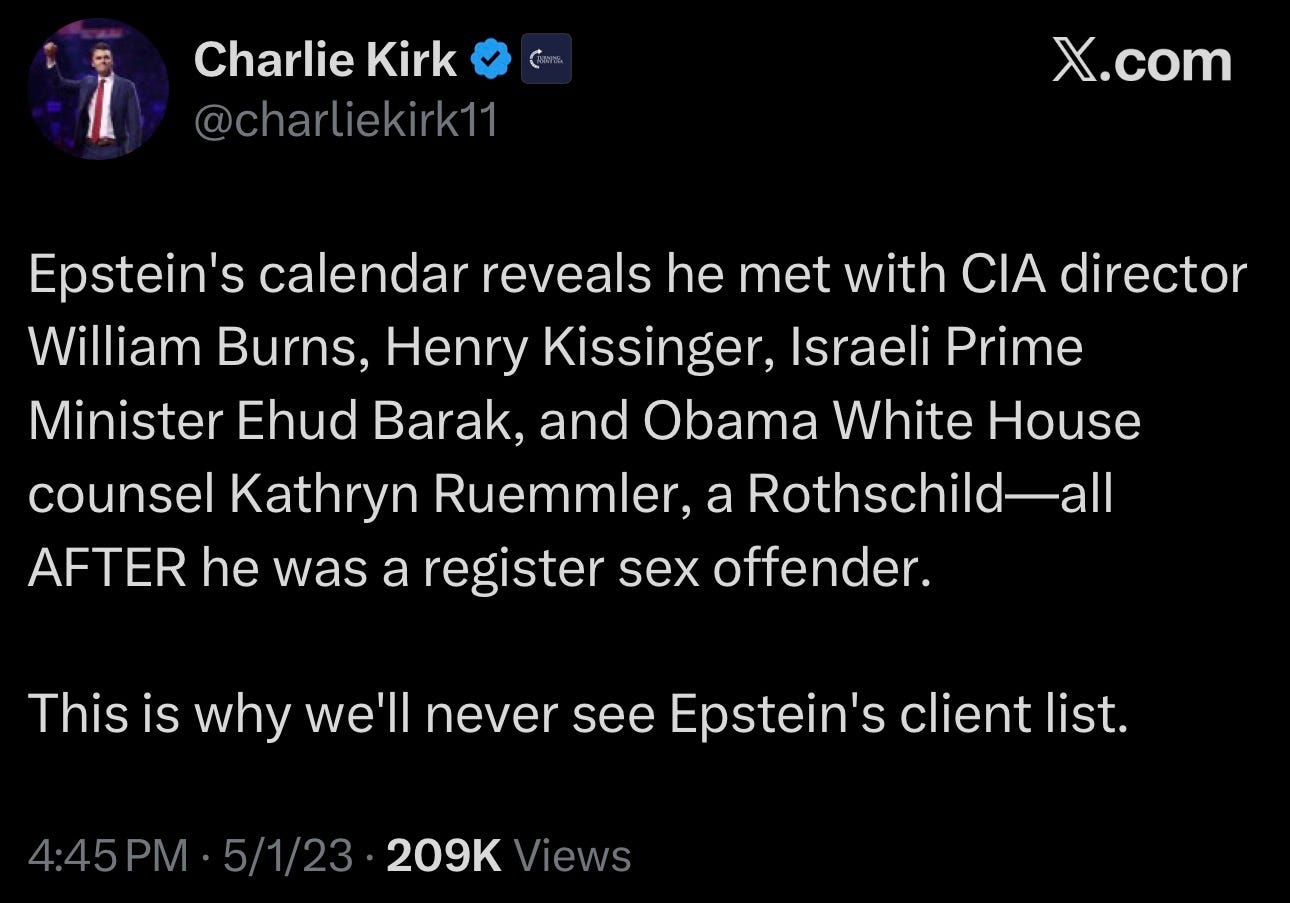
The world is waking up to the fact that the foreign nation of Israel has a stronghold on United States politicians. The Epstein scandal goes far deeper than sexual crimes and hits at the very foundation of the financial infrastructure that made the United States the financial capital of the world. Jeffrey Epstein, in partnership with the imperial intelligence apparatus (CIA, Mossad, MI6, ex-KGB), was able to infiltrate our financial system in a way no foreign government has ever been able to. The autocratic nation bloc of Brazil, Russia, India, China, Saudi Arabia, Israel and Qatar (BRICSIQ+) has exploited this hole in the American institutions to overtake our academic and legal systems in an attempt to dismantle the financial system from the inside. The crown jewels of the intelligence apparatus and foreign governments are the GENIUS Act and CLARITY Act.
How the Network Operates
The thing is, this scandal spreads across the entire financial world beyond anything I could have ever imagined. It gets to the core of our international institutions and the regulated financial system. The illegal e-currency espionage operation that he funded ties into the Bank of International Settlements and its shareholders (FED, ECB, BOJ, BOE, SNB, etc), the associated member banks (examples: JP Morgan, Citibank, Bank of America, Wells Fargo, Deutsche Bank, etc.), and the shadow financial system (hedge funds, private credit, private equity, venture capital). He eventually was able to fund the most illicit part of the infrastructure: the digital counterfeiters (aka cryptocurrencies). Howard Lutnick serves as the bridge between the bankers (Cantor Fitzgerald) and counterfeiters (Tether). The stablecoin infrastructure is the primary mechanism that stole the 2024 election, with an illicit activity rate 8,863,000% higher than that of the regulated financial system.
This criminal scandal spans international institutions, NGOs, and non-profits like the World Economic Forum, International Monetary Fund, Bretton Woods Committee, Council on Foreign Relations, World Bank, Atlantic Council, etc. The U.S. taxpayer, in effect, has been getting looted by foreign governments and our own politicians, with that money funneled back into NGOs and nonprofits to dismantle the U.S. Constitution. The issue is this extends far beyond the United States borders. This transnational criminal scheme includes the tax shelters of Luxembourg, Brussels, Ireland, the Cayman Islands and others. The whole plan is to dismantle global democracies.
Why FOIA Matters
Today, I am sharing my first FOIA request to the primary agency where this criminal conspiracy was handed off to during the Obama administration in 2009: the CFTC. FOIA is how we get the transparency we deserve between Congress, executive agencies, PACs and SuperPACs, the private firms dismantling the rule of law and the journalists aiding in the cover-up. We must pursue accountability at the highest levels of leadership, not scapegoat lower-level employees. To those that cooperate, give them grace. The people orchestrating this criminal scheme should be tried for racketeering, seditious conspiracy, espionage, and treason.
To Congress:
Invoke Article 2, Section 4 of the U.S. Constitution:
“The President, Vice President, and all civil officers shall be removed from office on impeachment for, and conviction of, treason, bribery, or other high crimes and misdemeanors.”
If these words still carry meaning, they must be enforced.
No more protection of power. No more selective accountability. No more erosion of the rule of law.
Hold every actor accountable (foreign and domestic) through lawful process and constitutional duty.
Vive la révolution.
Freedom of Information Act Request – Communications Between CFTC Leadership and Digital Asset Entities (2009–Present)
Dear FOIA Officer:
On behalf of the American people, I hereby submit this Freedom of Information Act (“FOIA”) request to the Commodity Futures Trading Commission (“CFTC” or “Commission”) for agency records relating to communications between CFTC leadership and certain digital asset companies and related entities. This request is made pursuant to FOIA, 5 U.S.C. § 552, and the CFTC’s implementing regulations, 17 C.F.R. Part 145. We seek these records for non-commercial, public-interest purposes, as detailed below.
Description of Requested Records
Time Frame: January 1, 2009 through the present (the date the CFTC begins its search and processing of this request). The request is intended to cover all responsive records created or obtained by the Commission during this period.
CFTC Officials Covered: This request encompasses records in the custody or control of any individual who served as a Commissioner or as the Chair (including Acting Chair) or General Counsel of the CFTC at any time from January 1, 2009 to present. This includes, but is not limited to, the following current or former officials (with their service noted):
Walter L. Lukken (Acting Chairman in 2009)
Michael V. Dunn (Acting Chairman in 2009; Commissioner through 2011)
Gary Gensler (Chairman, 2009–2014)
Jill E. Sommers (Commissioner, 2007–2013)
Bart Chilton (Commissioner, 2007–2014)
Scott D. O’Malia (Commissioner, 2009–2014)
Mark P. Wetjen (Commissioner, 2011–2015; Acting Chairman in 2014)
Timothy Massad (Chairman, 2014–2017)
Sharon Y. Bowen (Commissioner, 2014–2017)
J. Christopher Giancarlo (Commissioner, 2014–2017; Acting Chairman in 2017; Chairman, 2017–2019)
Brian D. Quintenz (Commissioner, 2017–2021)
Rostin Behnam (Commissioner, 2017–Present; Acting Chairman in 2021)
Dawn D. Stump (Commissioner, 2018–2022)
Dan M. Berkovitz (Commissioner, 2018–2021)
Heath P. Tarbert (Chairman, 2019–2021)
Christy Goldsmith Romero (Commissioner, 2022–Present)
Kristin N. Johnson (Commissioner, 2022–2025)
Summer K. Mersinger (Commissioner, 2022–2025)
Caroline D. Pham (Chair, 2022–2025)
Mike Selig (Current Chair)
Terry Arbit
Ann Wright (Acting General Counsel, 2009–2011)
David Van Wagner (Acting General Counsel, 2011–2013)
Jonathan L. Marcus
Daniel Berkovitz
Myra Oliver (Acting General Counsel, 2013–2014)
Daniel J. Davis (Acting General Counsel, 2014–2017)
Robert A. Schwartz (Acting General Counsel, 2017–2021)
Christopher J. Kirkpatrick (Acting General Counsel, 2021)
Meghan Tente (Acting General Counsel, 2021–2024)
Tyler Badgley (Present)
For each of the above-listed officials, this request includes records maintained by, sent from, or sent to the official or their office/staff in their official capacity at the CFTC.
Entities and Individuals of Interest: We seek all records of communications (sent or received) by any of the above CFTC officials, and all records referencing or relating to those communications, that involve any of the following entities or their representatives:
Coinbase, Inc.
Ripple Labs, Inc.
Anchorage Digital (Anchorage Digital Bank or its affiliates)
Gemini Trust Company, LLC
Circle Internet Financial, Inc.
Tether Limited (and related entities issuing “Tether” stablecoins, which includes Bitfinex)
Andreessen Horowitz (a16z and its affiliates)
Consensys (and its affiliates)
X/Twitter (and its affiliates)
Amazon (and its affiliates)
Google (and its affiliates)
Microsoft, OpenAi (and its affiliates)
Palantir (and its affiliates)
Erebor (and its affiliates)
TikTok (and its affiliates)
Oracle (and its affiliates)
Meta (and its affiliates)
Visa (and its affiliates)
Mastercard (and its affiliates)
Kalshi (and its affiliates)
Sullivan & Cromwell LLP (outside counsel or lobbyists for digital asset firms)
Paul, Weiss, Rifkind, Wharton & Garrison LLP (same)
Latham & Watkins
BakerHostetler LLP (same)
WilmerHale
Jones Day
Skadden, Arps, Slate, Meagher & Flom LLP and Affiliates
Davis Polk & Wardwell
Paul Hastings
Jenner & Block
Milbank LLP
Perkins Coie
Ropes Gray
Quinn Emanuel
Morgan, Lewis & Blockius LLP
Orrick, Herrington & Sutcliffe LLP
Potomak Global Partners LLC
Any other outside law firm, legal counsel, or lobbyist known to represent any of the above companies or the Blockchain Association in matters involving digital asset regulation or enforcement. (This part of the request is intended to capture communications with outside attorneys or firms acting on behalf of the above-listed entities or similar industry groups.)
Additional Entities and Counterparties of Interest
In addition to the entities listed above, this request further encompasses all records of communications (sent or received), as well as all internal CFTC records referencing or relating to communications, involving any of the following entities, organizations, financial institutions, academic institutions, trade associations, or affiliated representatives:
Financial Market Infrastructure and Payment Networks:
Society for Worldwide Interbank Financial Telecommunication (“SWIFT”)
The Board of Governors of the Federal Reserve System and any Federal Reserve Bank
Any Federal Reserve-sponsored digital asset, payment, or settlement initiative
Federal Executive and Oversight Agencies:
The Government Accountability Office (“GAO”)
The Central Intelligence Agency (“CIA”)
The Secret Service
The Federal Bureau of Investigation (“FBI”)
The Securities and Exchange Commission (“SEC”)
The Office Comptroller of the Currency (“OCC”)
The U.S. Treasury (Including sub-agencies like “FinCEN” and “OFAC”)
The Federal Deposit Insurance Corporation (“FDIC”)
The Department of Government Efficiency (“DOGE”)
Any other Executive Branch department or agency engaged in interagency coordination concerning digital assets, stablecoins, payment systems, or financial market infrastructure (to the extent communications were maintained by or transmitted to/from the CFTC officials identified above)
Major Financial Institutions and Broker-Dealers:
Goldman Sachs & Co. LLC
The Bank of New York Mellon Corporation (“BNY Mellon”)
Citigroup Inc. (“Citi”)
Bank of America Corporation
JPMorgan Chase & Co.
Standard Chartered
U.S. Bankcorp
Wells Fargo
Morgan Stanley
Bridgewater Associates
Cantor Fitzgerald
Citadel (including Citadel Securities and affiliated entities)
CME Group
CBOE Global Markets
Bullish
Nasdaq
TD Bank (and its broker dealer/affiliates)
Asset Managers and Investment Firms:
Fidelity Investments (including Fidelity Digital Assets)
Franklin Templeton
BlackRock, Inc.
Grayscale Investments
Paradigm (venture capital firm focused on digital assets)
BNY Mellon Investment Management
KKR (and its affiliates)
Apollo (and its affiliates)
Digital Asset Exchanges, Platforms, and Market Participants:
Kraken
Crypto.com
MoonPay
Galaxy (and its affiliates)
Robinhood Markets, Inc. (including Robinhood Crypto)
Kalshi
Polymarket
Uniswap Labs
Chainlink Labs
TRM Labs
Gemini Trust Company, LLC (to the extent not already covered above)
Policy Organizations, Advocacy Groups, and Industry Associations:
Blockchain Association (industry advocacy group) Coin Center
The Digital Chamber (also known as The Chamber of Digital Commerce)
DeFi Education Fund
Crypto Council for Innovation
American FinTech Council
Academic Institutions and Research Centers:
Massachusetts Institute of Technology (“MIT”), including any affiliated digital currency or fintech research laboratories
Harvard University
Georgetown University
The Wharton School of the University of Pennsylvania
Columbia University
New York University (“NYU”)
Fordham University
Stanford University
Media and Journalistic Outlets:
Bloomberg (and its affiliates)
Thompson Reuters (and its affiliates)
The Financial Times (and its affiliates)
The New York Times
The Wall Street Journal
Politico
Roll Call
Punchbowl News
This request includes communications with any officers, directors, employees, advisors, consultants, registered lobbyists, outside counsel, or other representatives acting on behalf of the foregoing entities.
Congressional Offices and Legislative Counterparties:
This request further includes all records of communications (sent or received), as well as internal CFTC records referencing or relating to such communications, involving Members of Congress, congressional committees, committee staff, or congressional offices engaged in legislation, oversight, or policy development concerning digital assets, stablecoins, derivatives, financial market infrastructure, or CFTC jurisdiction.
Without limitation, this includes communications with:
Any Member of Congress who sponsored, co-sponsored, drafted, or publicly supported legislation commonly referred to as the “GENIUS Act” or any substantially similar digital asset, stablecoin, or market structure reform legislation;
The personal office of Representative Abigail Spanberger;
Any Member of the U.S. House of Representatives or U.S. Senate serving on committees or subcommittees with jurisdiction over the Commodity Futures Trading Commission during the relevant time period.
This specifically encompasses, but is not limited to, communications involving:
The House Committee on Agriculture;
The Senate Committee on Agriculture, Nutrition, and Forestry;
The House Committee on Financial Services;
The Senate Committee on Banking, Housing, and Urban Affairs;
Any subcommittee exercising jurisdiction over derivatives markets, commodities regulation, digital assets, or financial innovation;
Majority and minority committee staff, policy advisors, legislative directors, or counsels acting on behalf of such Members or committees.
For avoidance of doubt, this portion of the request includes:
Direct communications between covered CFTC officials and Members of Congress or their staff;
Draft legislative language, technical assistance memoranda, or policy comment letters provided by the CFTC to congressional offices;
Briefing materials, talking points, or preparatory memoranda created in connection with congressional testimony, hearings, markups, or legislative negotiations involving digital asset policy;
Internal CFTC communications summarizing, referencing, or discussing meetings, calls, or legislative strategy involving congressional offices.
This section is intended to ensure that the Commission’s search captures the full scope of interactions between CFTC leadership and legislative branch actors concerning digital asset regulation, market structure reform, and oversight of Commission activities.
For avoidance of doubt, the request covers:
Direct communications between any covered CFTC official (or their staff) and any representative of the above-listed entities;
Internal CFTC communications referencing meetings, calls, regulatory discussions, enforcement considerations, policy development, rulemaking, or legislative coordination involving these entities;
Interagency communications involving these entities where the CFTC was a participant or recipient;
Draft memoranda, briefing materials, white papers, proposed rule text, policy frameworks, talking points, or background materials prepared in connection with meetings or discussions involving these entities;
Communications relating to stablecoins, digital asset market structure, tokenized financial instruments, derivatives referencing digital assets, central bank digital currency initiatives, payment settlement modernization, or cross-border digital asset infrastructure.
This expanded list is intended to ensure that the Commission’s search reasonably captures the full scope of interactions between CFTC leadership and (i) major digital asset market participants, (ii) systemically important financial institutions, (iii) asset managers engaged in digital asset products, (iv) payment and settlement infrastructure providers, (v) academic institutions involved in digital asset research, and (vi) policy organizations or advocacy groups active in digital asset regulation.
In summary, we are seeking all records of communications between any of the covered CFTC officials (or their offices) and any representative, employee, agent, or legal counsel of the above-listed companies and organizations. This includes direct communications (such as emails or letters exchanged with those entities or their lawyers) as well as internal CFTC records that reference or relate to those entities or any communications with them (for example, meeting agendas, briefing memos, or notes that discuss a meeting with one of those companies).
Types of Records Covered: We seek any and all forms of records in the possession of the CFTC (including the offices of the officials listed above) that are responsive to the description above. This includes, without limitation:
Emails (including attachments) and written correspondence (whether in paper or electronic form) sent to or received from any of the listed entities or their representatives, using official CFTC email accounts or communication channels.
Internal memoranda or correspondence within the CFTC (including letters, instant messages, or other inter-office communications) that discuss or mention any of the listed entities or their representatives.
Calendar entries, agendas, and scheduling documents for any meetings or calls involving the listed entities. (For example, an official’s calendar entry showing a meeting with representatives of Coinbase, or agenda/briefing materials prepared for such a meeting.)
Meeting notes, minutes, summaries, or transcripts arising from any meeting or call (whether internal or with outside parties) that involved discussion of any listed entity.
Telephone call logs or records of calls maintained by the officials or their staff, to the extent such logs indicate calls with any person affiliated with the listed entities.
Briefing books, talking points, or other preparatory or background materials prepared for any CFTC official in advance of meetings, calls, or events involving any of the listed entities (or discussing issues relating to those entities).
Handwritten notes taken by the official or their staff that reference any of the listed entities (for example, notes jotted during a meeting or phone call).
Chats or messages on encrypted or electronic messaging platforms used for official business by any covered official (such as text messages, Signal, WhatsApp, or similar), if they contain discussions of official CFTC business with or about the listed entities. (We include these to ensure that if any official conducted agency business through such channels, those communications are captured, consistent with federal records obligations.)
Any other record that memorializes, summarizes, or refers to communications or meetings between any covered CFTC official and any of the listed entities or their representatives.
We request that all segregable portions of responsive records be produced. If some parts of a record are exempt from disclosure, please redact the exempt portions and release the rest. The CFTC’s FOIA policy explicitly states that if exempt information can be reasonably segregated, the remainder of the record will be released , consistent with 5 U.S.C. § 552(b). In other words, please release any non-exempt information contained in otherwise exempt records.
Reasonable Description and Search Parameters
For purposes of 17 C.F.R. § 145.7(d), this request reasonably describes the records sought with sufficient specificity to permit identification and retrieval. The request is limited to:
A defined time period (January 1, 2009–present);
A defined set of custodians (enumerated CFTC Chairs and Commissioners, General Counsel and their official offices);
A defined set of counterparties (the specifically identified entities and their representatives);
Defined categories of communications (emails, correspondence, meeting materials, memoranda, call logs, advisory committee materials, and related documentation).
To facilitate efficient processing, the Commission may conduct keyword searches across official email domains using the names of the listed entities and known variants (e.g., “Coinbase,” “CB Global,” “Ripple,” “XRP,” “a16z,” “Andreessen,” “Sullivan & Cromwell,” “S&C,” etc.) in combination with the custodians identified above.
Format of Production
We request that all records be provided in electronic format to the extent possible. The FOIA and the Commission’s rules allow requesters to specify the preferred format of disclosure, including electronic formats. We prefer to receive the records in a text-searchable digital format (such as PDF or native electronic format), with metadata preserved. For example, emails should be produced as electronic .pst files or PDFs that show the sender, recipient, date/time, and subject fields, and include any attachments. Electronic production will reduce the need for reproduction costs and will facilitate a more efficient review of the records.
If any records exist only in paper form, we request that they be scanned and produced as PDFs. We are willing to receive the records via email, secure download link, or on electronic media as needed.
We request production in native format where practicable, including associated metadata fields (such as date created, date modified, author, recipients, subject line, and file path). Metadata is part of the record under FOIA where maintained in the ordinary course.
We further request written confirmation identifying:
The custodians searched;
The search terms used;
The date ranges applied; and
The record systems searched.
Fee Waiver Request
Pursuant to 5 U.S.C. § 552(a)(4)(A)(iii) and 17 C.F.R. § 145.8(d), we respectfully request a waiver of all fees associated with the processing of this request. Disclosure of the requested records is in the public interest because it is likely to contribute significantly to public understanding of the operations and activities of the government, and the request is not primarily in the commercial interest of the requester.
Public Interest
The requested records concern communications between senior officials of the Commodity Futures Trading Commission and major participants in the digital asset, financial services, and market infrastructure sectors. The scope, frequency, and substance of such communications bear directly on the Commission’s regulatory, supervisory, enforcement, and policy development activities in a rapidly evolving and economically significant area.
Digital asset regulation, stablecoin oversight, market structure reform, and interagency coordination regarding financial innovation are subjects of ongoing public debate, congressional oversight, and significant media attention. Disclosure of these records will enhance public understanding of:
The manner in which the Commission engages with regulated entities and market participants;
The development of regulatory frameworks and enforcement priorities in the digital asset space;
The extent of coordination between the Commission and other federal agencies or financial institutions regarding digital asset markets.
The requested materials therefore directly relate to identifiable “operations or activities of the government” within the meaning of FOIA and would contribute meaningfully to informed public discourse.
The requester intends to analyze, synthesize, and disseminate the information obtained through publicly accessible channels, including written analysis and reporting. The information will be made available to the public at no charge and will be used for research, educational, and informational purposes.
Segregability and Exemptions
If you determine that any portion of a responsive record is exempt from disclosure, please provide the non-exempt portions of the record. FOIA requires that “any reasonably segregable portion of a record” be released after redaction of exempt portions (5 U.S.C. § 552(b)). The CFTC’s own policy confirms that non-public records will be released if they are not exempt, and that segregable exempt information will be deleted so that the remainder can be disclosed. We request that you err on the side of disclosure and exercise any discretionary powers to release records that may technically fall within an exemption but where no foreseeable harm would result from disclosure (see FOIA Improvement Act of 2016, Pub. L. No. 114-185).
For any record or portion of record that you withhold under a claim of exemption, please provide a detailed Vaughn index or description of the withheld material. Such an index or written description should, at a minimum, identify the date, sender/recipient, subject matter, and the specific FOIA exemption claimed for each withheld record or redacted portion. This will allow our client to understand the basis of the withholding and, if necessary, to properly exercise the right to an administrative appeal or to seek judicial review. We trust that the Commission will comply with its obligation to release all segregable information and to justify any withholdings with particularity.
Pursuant to 5 U.S.C. § 552(a)(8)(A), the Commission may withhold information only if it reasonably foresees that disclosure would harm an interest protected by a specific exemption. Conclusory assertions of harm are insufficient. We request that any withholding explicitly articulate the foreseeable harm standard applied.
Processing and Contact Information
We request that this FOIA request be processed on an expedited basis to the extent possible, as it concerns an ongoing public debate on cryptocurrency regulation. In any event, we expect a determination on this request within the 20-business-day statutory time frame as required by 5 U.S.C. § 552(a)(6)(A). If “unusual circumstances” arise that may delay the response, please inform us in writing before the 20-day period expires.
Preservation of Records
To the extent any responsive records are subject to routine destruction, auto-deletion, or archival policies, we respectfully request that the Commission preserve all potentially responsive records pending final resolution of this request, including administrative appeal, consistent with federal records obligations.
Thank you for your prompt attention to this matter. I appreciate the CFTC’s courtesies in responding to FOIA requests and the Commission’s commitment to transparency. I look forward to your response and the release of the requested records.
Sincerely,
Troy Root
The Response
The above FOIA was an expanded version of my original FOIA request in April of 2025. They responded 8.5 months after their statutory deadline with the following:
“We are denying your request for a fee waiver. We have found that you have not demonstrated that disclosure of the requested records is likely to contribute significantly to the public understanding of the operations or activities of the government…
We estimate that the cost to process your request would likely exceed $100,000.00. Please provide sufficient fee authorization so that we may proceed to process your request.
At this time, you have not provided any fee authorization. We will not begin processing your request until you have provided the fee statement referenced above. If you wish to continue with your request as written, please provide the written fee statement to the Commission’s Office of the General Counsel (“OGC”) on or before March 10, 2026. If the Commission’s OGC does not hear from you in writing by March 10, 2026, your request will be administratively closed without prejudice to your right to submit a revised request to the Commission in the future.”
After obstructing justice and responding 8.5 months after the statutory deadline, this is how our government responds. I have responded to their deadline on March 10th. I have yet to receive a response. Rosemary B. Killoy is the assistant general counsel currently mishandling the request at the CFTC.